
50 by 50 Item #4: Trace my family tree on my Italian side further back than my great-grandparents.
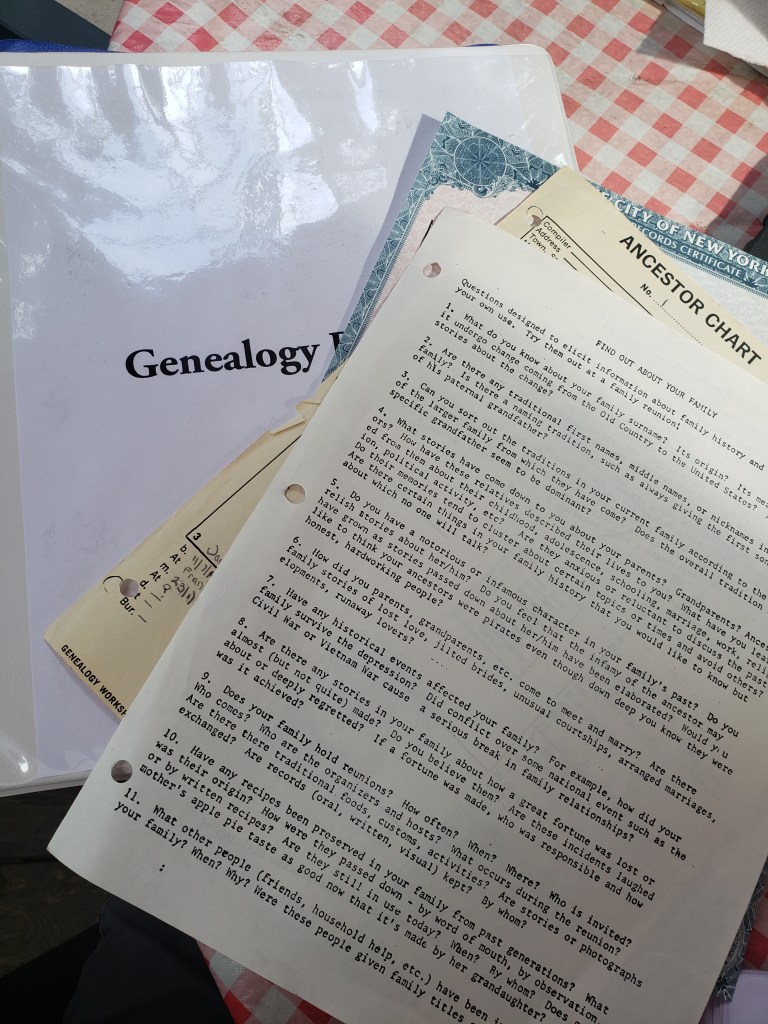
When I was in the seventh grade, we took time out of our study of the first half of American history to research our family trees. It’s the type of project that has fallen out of favor in recent years because not every family has a histroy that is fun to explore or happy, which I get but at the same time find to be kind of a bummer because exploring where you come from teaches real-world research skills that cannot be Wikipedia-ed or AI-ed. Then again, I’m sure my students would find a way to cheat on even that.
Anyway, back in 1989-1990, I had to rely on the recollections of relatives and what few records were accessible in my family as well as my small town on the South Shore of Long Island. And that wasn’t much. A t least both of my grandmothers were alive back then, so I could get some names onto an ancestor chart. When it came to my mom’s side of the family, I was fortunate to have a great uncle who had done some looking into our past and traced my maternal grandmother’s lineage from Long Island through Newfoundland to early 19th Century England. Otherwise, I hit dead ends with my great-grandparents. I knew I was part German and part Italian (the Italian last name should have clued me in), but where in Germany and where in Italy were unknown.
I supplemented the family history information with some geographical and historical information s well as a look into the meaning of my last name (it has something to do with bread crumbs) and got an A. With the exception of my sister using it when she had to do the project three years later, it sat in a file folder for at least a decade until I discovered both the Internet and office downtime. That was in the early 2000s when the Internet still had a number of thriving message boards and while Ancestry.com did exist, it hadn’t solidified its monopoly on online genealogy. Most of the research you wound up doing was scouring board posts, public record sites, and buying software like Family Tree Maker (which I still have). Posting and reading Newfoundland GenWeb was how I traced my English ancestry even further back, to 1757, and that led to me to produce an entire family ihistory booklet for a reunion in 2001. Several years later, I’d get a stack of information about my maternal grandfather’s side of the family, but the Germans and Italians on my dad’s side continued to allude me.
Now, it’s not hard to find an Italian on Long Island, so it’s not like I was unaware of what “being Italian” meant, although if I’m being honest, I spent much of my early adulthood trying to get as far away from my Italian-American-ness as possible. I guess my perception of “being Italian” had been warped by the media and it became embarrassing. Wouldn’t you be embarrasssed when the first image that comes to mind when you think “Italian” is some piece of gabbagool Jersey Shore trash?
And I’m not going to lie; this still bothers me. I even have a whole essay about it that’s on its billionth draft. But it didn’t kill my curiosity about my family history. I’d pick it up every once in a while to see if I could glean any new infromation from what sources I had and always wound up with two things: my great-grandfather’s frist name (Joseph) and that my family was from Brooklyn. It wasn’t much to go by–Joseph is about as ubiquitous a name as Maria (which was my great-grandmother’s name, by the way), and in the first half of the 20th Century, Brooklyn was its own region of Italy.
So, looking through Italian GenWeb sites and other online databases in the early 2000s came up with nothing an dfor years, the only record I had verifying that the names my grandmother gave me years ago were accurate and that my great-grandfather was born in Italy was my grandpa’s Social Security application from 1944. I figured that was all I was ever going to get and put my research away. Then, a few yars ago, my mom was having another reunion of the surviving members of my grandmother’s generation (the woman was one of something like eleven kids and there’s still a few alive) and asked me if I could do an update of the project I’d done about 20 years earlier. I jumped at the chance, added a bunch of names to my family tree, and once that was produced, looked at my dad’s side of the family again. The U.S. Census Bureau had just released the 1950 census data and created a searchable database, so I looked up my dad’s name to see if I could find out where in Brooklyn the family lived before moving to Nassau County. Not only was my dad and his older brother on the census with my grandparents, buy my great-grandfather was as well. Plus, his age was listed, so I had a possible birth year.
I’d like to say that everything fell into place at that moment, but life got in the way and I had to put the genealogy aside, telling myself I’d get back to it when I got the chance. Then, a few weeks ago, my kid was taking driver ed at the high school and I decided to kill a couple of hours every afternoon at the library. I’d browse, flip through books, and check things out, but then I discovered that the library had free access to Ancestry.com. That’s huge because a membership on Ancestry.com ranges from $20-$50 depending on how much access you want. Plus, over the years, Ancestry has gobbled up all of those old message boards, websites, and free genealogy tools. Some have remained free but others have been stuck behind a paywall, making my research harder.
I organized my notes, which still included that 35-year-old school project–and took them to the library. They quest was the identity of people beyond my paternal great-grandparents. Two weeks later, as the kid took their road test, I had names on the German side (and hit a dead end with an name like “Peter Hahn” or something everyday Deutsch) but only found more information on my Italian great-grandparents that did not include their parents’ names. It was cool, though, finding ship manifests from the late 1800s and early 1900s as well as census records from Brooklyn that had specific street addresses. I also got the place in Italy that my family hails from–S. Archangelo, which is in the southern part of the country near Naples– something that had been alluding me for years (my dad always insisted we were Northern Italian because of our lack of distinctive Sicilian features; I’m pretty sure that’s the German genes doing their stuff). And it was a lot of fun trying to match names to dates to known family members, even if I had more misses than hits.
Then, I stumbled upon death.
More accurately, I found the New York City Department of Health database. They have searchable death certificates that you can download for free if they were prior to a certain year (I think 1940). That didn’t help me, of course, since my great-grandfather was alive in 1950, but after interacting with a chat bot, I discovered that you could request a record for a fee of $25. I had an address, the names of his children, his approximate age, and a possible year of death based on what I found at findagrave.com, so I entered the information, paid, and sent the request. I didn’t expect to get much except for a record to keep, but two weeks later, I opened the envelope to see not only things I already knew, but two names: his father and his mother.
Thirty-five years after I had started this whole thing, I’d made a breakthrough. Now, it’s a small breakthrough at the moment because we’re looking at an Angelo and a Maria (seriously, the Marias!), and my research yesterday at the library didn’t come up with much, but if there is one thing that I have learned when researching your family history, it’s that when looking for the metaphorical needle in a haystack (in this case, a Maria in Italy), you’re going to have to be very patient and do a lot of turning around.

