
I tested positive for COVID on Sunday. It wasn’t a surprise because everyone else in the house had it, and I was fortunate enough to just wind up with a really bad cold for most of the week. As I type this, I’m pretty much better but taking it easy for one more day just to be on the safe side. Plus, there’s movies to watch. And tennis.
No, seriously. If you want some background noise that you can doze off to when sick, turn on Wimbledon.
Speaking of which, I spent much of the week reading comics and watching movies. During the first couple of days of being sick, when I was utterly exhausted every minute of the day, it was all I could really concentrate on (as opposed to the “serious literature” that is the next Required Reading book). As a result, I knocked out more than a few things on my list. So here are some mini reviews of what I’ve watched and read.
Movies

Star Trek: The Motion Picture — The Director’s Cut. This was originally released on DVD back in the early 2000s and I’d always meant to pick it up, but never got the chance. For the better part of thirty years, I’d only ever seen ST:TMP on VHS via the “Special Longer Version” that Paramount released back in the mid-1980s. My dad bought it via Columbia House’s video club and it had a black and gold box because it was Paramount’s 75th Anniversary or something. ANYWAY, a few years ago, I got the first six movies on blu-Ray in a boxed set and I finally saw the theatrical cut in widescreen. I’d always been a fan of the film but it made the experience much better. I knew of the director’s cut and when the 4K release came out, I put it on my wish list. This week, I finally got the chance to check out this Christmas gift.
It’s so worth it. Everything looks great and sounds great, the effects are sharpened and “finished” in some cases but don’t have that “Star Wars Special Edition” feel, and you actually get to see the V’Ger ship during the climactic sequence. No, you can’t clean up lines like “Stop … competingiwthmeDecker” and no amount of digital enhancement is going to make Shatner’s toupee look good, but pithy comments aside, I’d grab this one. Keep.
Long Shot. A 45-minute Netflix documentary about a guy who was arrested for a murder that he didn’t commit and winds up being cleared because he was in a background shot of a sitcom that was being filmed the moment the murder took place. I’ll keep the summary vague in case you’re interested, but this was a good “snack” of true crime (I wasn’t in the mood for 90 minutes of murder), and for those of us who are familiar with the … well, bullshit … that the LAPD has pulled against people of color (our protagonist is Latino) will find the situation familiar and the resolution satisfying. Watch.
Break Point. My wife and I watched this over the course of the last couple of weeks. It’s a Netflix sports documentary that follows several high-profile tennis stars over the course of the 2022 season. Neither of us are giant tennis fans–we know enough of the superstars and have watched grand slam matches here and there over the years but I can’t say we’re invested–but this was still fascinating. You really get into the heads of these people, and the footage of their matches is beautiful and action-forward. It’s a fairly long series but you’ll find yourself watching two or three in a row. Watch.
To Kill a Mockingbird. I’d seen this film adaptation of Harper Lee’s novel years ago, but it was one of the final three movies on my Netflix DVD queue (because I wanted to rewatch it or something?), so I figured … why not. This is a classic film with Gregory Peck playing one of his most famous roles, Atticus Fitch. As far as an adaptation of the book is concerned, it does a pretty decent job of giving us the main stories–the trial of Tom Robinson and the kids’ fascination with Boo Radley–but it misses a lot of the nuance and layers that make the book so special.
That being said, it is still an emotional film that is incredibly effective. The performances are all perfect, especially Peck, whose closing statement speech at the trial is one of the best monologues in movie history. In fact, that goes on for something like six minutes and there isn’t a note of background noise or score in it, which you rarely see in films these days. The film understands the gravitas it has to give its subject matter and even the little moments contribute to that. I know that this novel and the movie have started to fall out of favor with people in my profession, and we can certainly have a discussion about how to reframe our approach to the book, but you can’t deny that To Kill a Mockingbird is one of the most important works of the 20th Century. Watch.
Comics
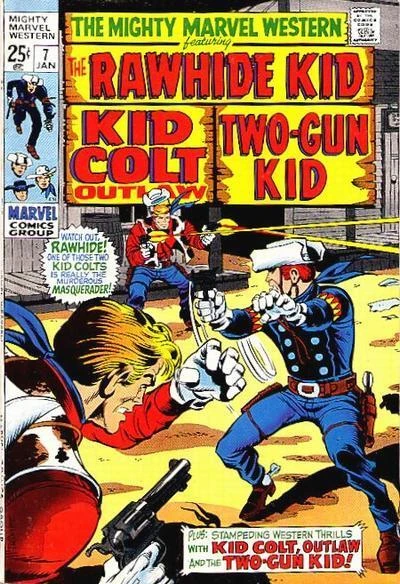
The Mighty Marvel Western #7 (Marvel). A book from the late Silver Age that is basically reprints of earlier Marvel western tales and a book that I grabbed for a quarter just so that I would have something to read for #WesternComicsMonth. I got the book for its cover price (sorry, no discount, Alan) and it’s beat to hell, so it’s not like this is a collector’s item steal. That being said, was it worth the read?
Well … if there’s a genre at the bottom of my list in any medium, it’s probably westerns. I’ve read the occasional comic or seen the occasional movie, but aside from some Jonah Hex stuff or movies like Unforgiven and Brokeback Mountain, I haven’t found much that I like. It’s not a genre I hate, mind you; it just never interested me.
This didn’t change my mind. These reprinted adventures of Kid Colt and Two-Gun Kid are fun to read and have some good, classic Marvel action with artwork by classic early Marvel artists like Larry Lieber and Dick Ayers, so it was definitely worth reading. But not a keeper. Trash.
Power Girl (1988) #1-4 (DC). I had the first two issues of this miniseries and finished out the book on DC Infinite. It spun out of her story in Secret Origins where she learned that she had no relation to Superman and was actually the granddaughter of Arion. That was a way to “fix” her after Crisis, although in the lead-up to Infinite Crisis, we’d learn that the Earth-2 history was actually true. I remember the Secret Origins story being really fun, and this was a way to establish her in the DCU by having her take on one of Arion’s old enemies and having her balance life as a superhero and life as a CEO. It reads as a pilot for what could have been an ongoing but I found it to be a misfire. Power Girl would wind up in the JLE soon after and ymmv as to how well she was handled as a character. This wasn’t a great start for it. Trash.
Legion of Super-Heroes (Bendis edition), Infinite Frontier, Dark Crisis on Infinite Earths (and several tie-ins). This wasn’t on my “official” unread list because the Bendis Legion book was one I bought off the shelf and read as it came out, but I had avoided any of the DC major events such as Infinite Frontier and Dark Crisis. They just cost too much and I knew that if I wanted, I could read them on DC Infinite at some point. So that’s what I did.
I decided to start with the Bendis Legion Millennium two-parter because the JLA/Legion miniseries was a Dark Crisis lead-in, and Bendis laid some groundwork for all of it in the issues leading up to it. I enjoyed this version of the Legion, although there were a few missed opportunities and things left unanswered when it ended (Why give Rose such importance in the lead-in if you’re just going to shove her into the background? What happened to the Green Lantern Corps and how did we get the Gold Lantern ring? What is Jon Kent’s history between the 21st and 31st Centuries?). The seeding of the “Great Darkness”, which was the major threat presented in Alan Moore’s classic Swamp Thing #50 (which I also read) and would be the catalyst behind Dark Crisis provided a good mystery and a good premise for the JLA/Legion series.
But then it kept coming back and it seemed that between Future State, Infinite Frontier, and Dark Crisis, we were simply getting different iterations of the same enemy. I guess that the whole “Metal”/”Death Metal” thing counts here too but I didn’t read that (although I probably should have because it kept getting referenced). Anyway, it kept coming back because it was this “thing” that was “out there” and people were using it or being used by it, and the big bad player in this was Pariah.
Yes, the whiny, constantly crying character from Crisis on Infinite Earths. That guy.
The conceit is that Pariah, who at some point was resurrected after being killed by Alex Luthor in Villains United, has been driven mad by his curse to follow destruction wherever it goes (although I thought he’d been “cured” of that at some point?) and has heard the call of the Great Darkness. He finds another Multiverse running parallel to our own and seeks to recreate the original multiverse. This plan involves capturing a bunch of huge-powered evil beings (like Darkseid) and “chaining” them to the darkness. It also involves “killing” the Justice League and imprisoning them in false paradise sceanrios. Oh, and getting Deathstroke to create a villain army to take out the remaining heroes.
If this sounds familiar, it’s because it’s rehash of so much of what we’ve seen over the last 20-30 years. And while it was entertaining, I compared it to a meal at The Cheesecake Factory: you pay a lot for a massive serving and it seems okay when you’re eating it but afterward you just feel as if you’ve eaten mass and not food. I wish DC could do a crossover that’s not universe-destroying or defining and doesn’t constantly rely on the same damn tropes. Oh, and I’m tired of Deathstroke being written like he’s a Doctor Doom-level villain. Skip.

