
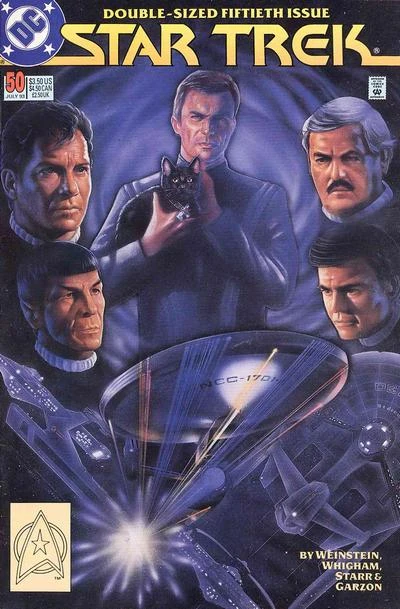
The vast majority of my digital comics are Star Trek books that were ripped from a DVD-ROM a few years ago (thanks to J. David Weter for sending it my way), and I’ve been slowly making my way through all of them. And the DVD-ROM, which came out sometime in the 2000s, was pretty comprehensive up until that point, containing the Whitman books of the 1960s and 1970s, the Marvel series of the early 1980s, all of DC’s books, and I believe some Marvel/Malibu books from the mid-1990s after DC lost the license.
I’d intended to start at the very beginning with the Whitman issues but was so eager to read all of the DC books that I actually started with Star Trek: The Motion Picture and the short-lived Marvel series before going right to DC (a gap in publication, by the way, meant that there was no comics adaptataion of Wrath of Khan until IDW did one many years later). As of right now, I’ve read all of the first two DC series.
I already covered the first DC series and had started to write about the second one when I decided that I’d wait until I was done with all of them and write a general review. And here we are.
My impression of the second series going in was that it wasn’t going to be as good as the first. I’d owned a few issues here and there back in the early 1990s and really didn’t remember anything about them aside from the awesome Jerome K. Moore covers (seriously, the man’s work was amazing and I think he was criminally underused by DC). I think the reason I heard it wasn’t as good was that the second series didn’t have its own cast of characters or continuity and focused on the main cast members (whereas the first one was closer to something like Marvel’s Star Wars). If there is a “continuity” for this particular series, it’s that there are stories that are mostly set between Star Trek V and Star Trek VI with a few that fall outside of that timeframe (I know of at least one or two stories that are post-ST VI because the Enterprise has a hole in the saucer and there are more than a few stories that take place during TOS). So it more or less reads like another television series with a story of the week and the occasional multi-part storyline.
As much as the “it’s not as good” is true, the book still was well-written and had solid art and that’s mainly because the creators involved had a real love for both Star Trek and those comics, something you could tell by reading the letercolumn. I enjoyed a number of the stories and found some completely skippable, which is often the case with any comic book or television series. Those that explored the crew in their old age were the most fascinating because it felt like an extension of the themes of the movie series.
The verdict isn’t really one. They’re all digital files that are stored on a hard drive, so all I did was take them off of my iPad and load up the Star Trek: The Next Generation books.
 The Uncollecting