
My experience with Mike Grell’s Green Arrow run is cursory at best. I’ve read The Longbow Hunters as well as the prestige-format Shado series and a few random issues, but for the most part it’s been a blind spot in my late 1980s DC reading. I know that the first 30 issues or so are on DC Infinite, so I have been considering reading through all of them in order to determine if I want to pick up any of the remaining comics. I guess these are a test run, then, because they came as part of a “mystery pack” that I bought from Third Eye Comics at last year’s Baltimore Comic-Con.
Well, issues #9 and #12 were not in that pack, but #10 and 11 are the middle chapters of a four-part storyline involving the return of Shado, so what I did was read the whole four-parter by reading the first and last parts on my iPad and the two print issues between them. I’m glad I did, too, because the book is a “mature read” that actually feels that way instead of throwing tits and curse words at you for 24 pages. The whole storyline centers around Shado and the Yakuza and Ollie being sent on an errand by the government to help take care of the situation. I don’t know if this is her first appearance since The Longbow Hunters, but there are a number of emotional beats in the story that call back to that miniseries, so I’m going to say it does. Either way, it was worth the read, even if it was to just look at Ed Hannigan and Dick Giordano’s artwork during what wind up being many silent panels of fighting.
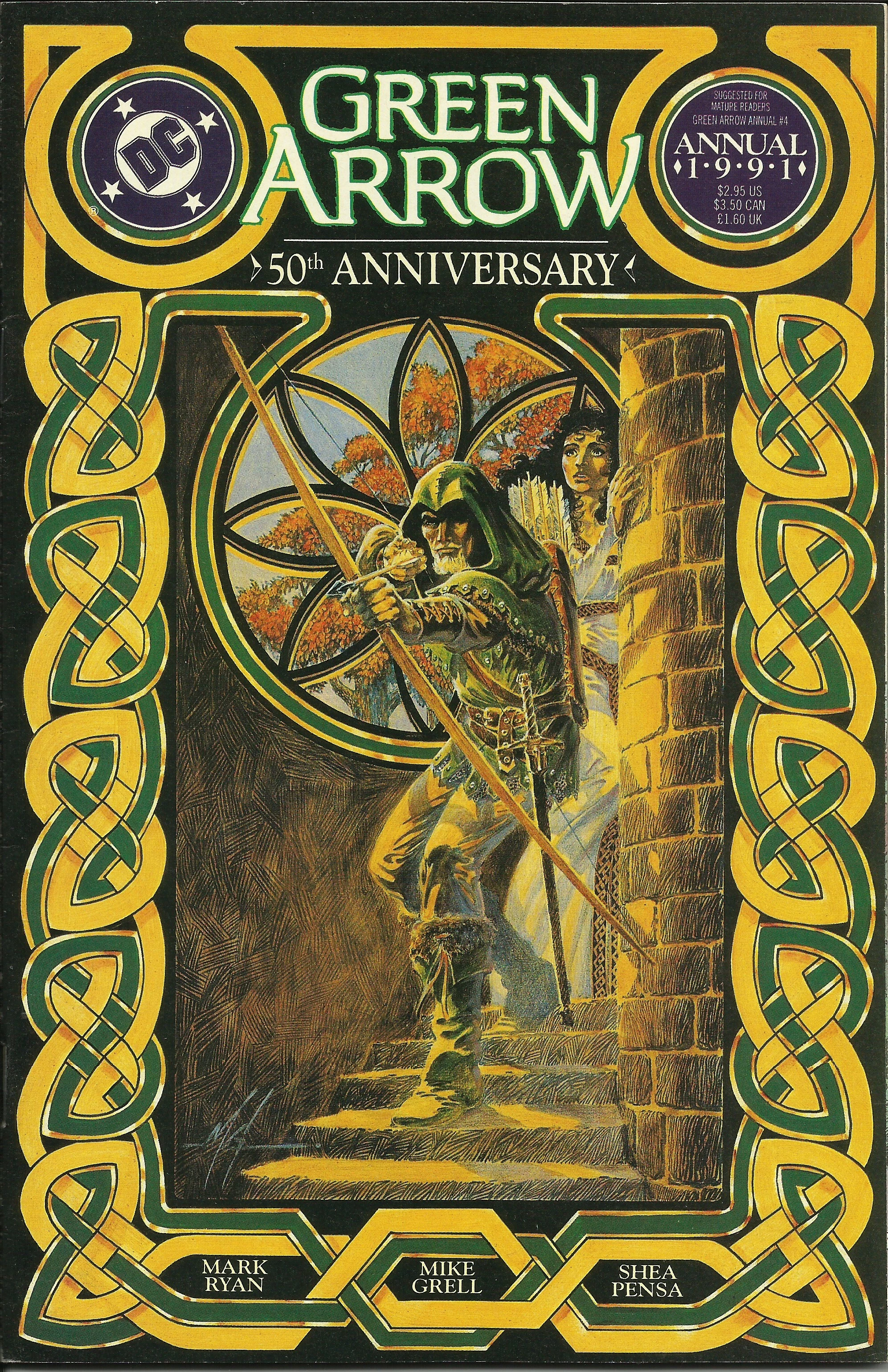
The annual was from 1991 (and had an Armageddon 2001 ad inside it … which gave me such nostalgia) and takes a well-known TV premise–a character finds themselves in the past or inside a fictional story–and gives us Green Arrow as Robin Hood as a way to celebrate the character’s 50th anniversary. It happens via Dinah Lance, who buys an amulet while in England and then is suddenly transported to Sherwood Forest of old and winds up being Maid Marian to Oliver’s Robin Hood. You get what you migth expect from a Robin Hood story along with a few magical moments, but as formulaic as this type of story is, it’s wonderfully engaging and there’s no filler. In fact, this is everything a self-contained annual should be.
The less said about that Brave and the Bold book, the better. It’s co-written by Grell and Mike Baron and is a team-up with Baron’s original character The Butcher. The story didn’t interest me, the art was pretty bad, and I found myself skimming through it.
Keep, Sell, Donate, or Trash?
Keep the annual. Get rid of the others.
 The Uncollecting