
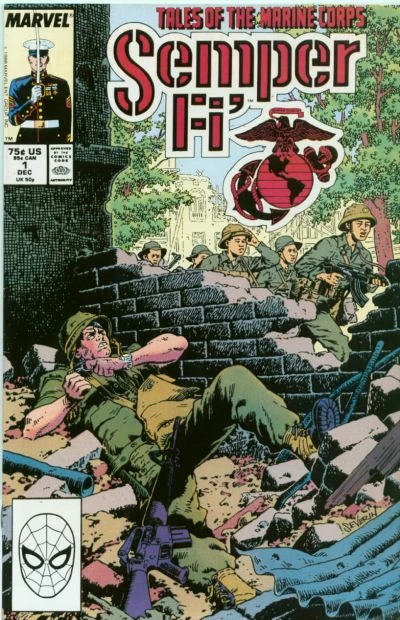
With the success of The ‘Nam in 1986, Marvel had a popular war comic that wasn’t a licensed product tie-in for the first time in … well, probably since Sgt. Fury and His Howling Commandos saw its last battle. And much like any other time you’ve got a successful property, there was a need to continue (or cash in on) that success. So, with writer Michael Palladino and editor Don Daley at the helm, they released Semper Fi: Tales of the Marine Corps. It was never billed as a miniseries but wasn’t successful because it only lasted nine issues in 1988-89, with issue #9 coming out in April 1989, the same month as The ‘Nam #33, which was the only other war comic being published at the time by either of the big two.
I’d been curious about this series for years after seeing house ads in old comics, but it wasn’t a book that was as ubiquitous in back issue bins as much as, say, many of Marvel’s superhero books, so I never really gave it much thought. That is, until a beat-up copy of issue #4 wound up in one of the Marvel grab bags I’d bought on a whim from my LCS. I read it along with the others in the grab bag and enjoyed it; then, I checked out Mike’s Amazing World of Comics to see how many issues there were. Nine didn’t seem like a hard back issue quest, so I decided to try and collect the series.
It took me three years.
Sure, I could have gotten on eBay, but I’m old school when it comes to this and like the thrill of finding the books in the wild. Plus, if I don’t commit to eBay, I’m less likely to spend the money. My LCS had a few issues, and I’d check the bins every so often to see if they’d got something in, but I always struck out. Then, I went to this year’s Baltimore Comic-Con and wound up getting the rest of the run for about $3 a comic. And while that’s expensive in terms of some (you know who you are), like I said on a recent Pop Culture Affidavit episode, $3 is cheap when you’re at a con and have a wad of cash that you’ve set aside specifically for the con.
So, was it worth all that effort?
Unlike The ‘Nam, which follows soldiers in one unit through much of the Vietnam War (up until the end of Doug Murray’s run and then it kind of skips around before we’re back with our original characters), Semper Fi is more like a war anthology comic, although there is a common thread of the Whittier family, which is composed of several generations of Marines. We get stories of one of the Whittier clan throughout American history, including Revolutionary War stories, the World Wars, and even Vietnam. Each issue also has a backup story unrelated to the Whittier clan and while Michael Palladino writes all of them, they’re drawn by classic war comics artists John Severin and Sam Glanzman as well as second-generation war comics artist Andy Kubert.
As a concept, it’s an interesting idea. Upon its execution, it only sort of works. The stories themselves are very entertaining, but the lack of an ongoing story meant it didn’t have the hook that it needed. Which is a shame, because I did enjoy the way that the book bounced around the various conflicts instead of grounding the stories in World War II, which is the common territory for war comics. They also get a little too rah-rah at times for me. Like I said with the earlier books, I understand that tends to be the case with a number of comics in this genre, but there were times where I felt that they were stepping over the line into Missing In Action or Rambo: First Blood Part II territory. And I get that a number of people like that and are looking for that in their war-related literature and media; I’m more for the contemplative war stories where the action punctuates the reality and the drama. They don’t have to be anti-war, but they need some pathos beyond just a buddy getting KIA. When Semper Fi actually did this–for instance, when we got a story of a Vietnam Vet at a reunion confronting one of his fellow platoon members about a battle gone wrong–it was at its best.
When it comes to art, the book is top notch. By getting Severin, Glanzman, and Kubert to draw the book, Marvel showed that they knew what the genre was about. Therefore, we don’t get the more stylized work that was becoming popular in 1988-89 (we were in the middle of McFarlane’s Amazing Spider-Man run and at the tail end of Marc Silvestri’s Uncanny X-Men; Liefeld was still on the Hawk & Dove miniseries and Jim Lee was just about to emerge) and instead get realistic looking scenes of war that serve their stories well. It is a bummer, by the way, that Semper Fi did not have a lettercolumn in most of the issues; I always enjoyed The ‘Nam‘s letter pages and that would have been cool to see.
I don’t think it’s anything that will get good money on eBay, especially since the condition of a number of the books is kinda crappy, but you never know. I’m going to hold onto it for now anyway and perhaps save it for next year.
Keep, Sell, Donate, or Trash?
Keep.
 The Uncollecting