
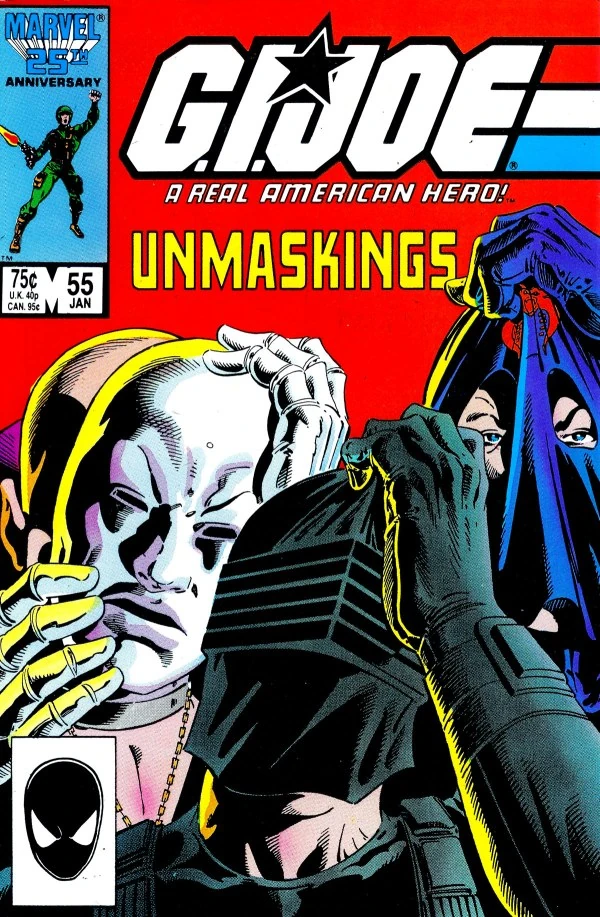
So, I started my #WarComicsMonth reading with G.I. Joe #55 and #59. And that begs the question: how do you review two comics that you’ve read multiple times but happened to randomly get in a grab bag? Moreover, how do you review two comic books that have always been two of the most important in your comic collecting history (and which you already covered)? I guess we’ll see how.
G.I. Joe: A Real American Hero was the first comic book title I became a hardcore fan of, even though I only collected it in 1987. As I detailed years ago in my “Origin Story” podcast miniseries, my friends and I spent most of that year–and especially that summer–collecting the book but our enthusiasm for it dropped off after the summer ended and we started the fifth grade. I’d obviously return to comics with Batman starting in 1990 but with the exception of buying the first several volumes of IDW’s reprint trades, never went back to the book.
My particular “run” on G.I. Joe was a scant seven issues starting with issue #59, although I did accumulate a number of back issues that covered the year leading up to that comic, so by the time I stopped collecting with issue #66, I had about two years’ worth of the run. Issue #59 isn’t a particularly landmark issue for the title and I’m pretty sure the only reason I bought it was because I’d been really into G.I. Joe at the time (after all, I had a ton of the toys) and that was the book that was on the stands at that point. But I’ll always have fondness for it because it was my first. Issue #55 on the other hand? That’s “Unmaskings,” with the cover featuring Destro, Snake-Eyes, and Cobra Commander taking off their masks, something which did happen (to an extent) inside the issue, and a comic that I own and have had signed by both Larry Hama and Mike Zeck (along with my copies of issues #46 and #61). When I was 10, I read this one I read until the spine rolled and the cover almost fell off. And I guess you could say that not only was this my first experience with comics collecting, but it was probably my first experience with War Comics.
Well, not in the traditional sense. G.I. Joe was a toy line that had comic book tie-ins and it happened to be about military-based characters. This wasn’t the World War II heroics of Sgt. Fury or Sgt. Rock, nor was it the gritty stories that Doug Murray and Michael Golden were telling in The ‘Nam. But I was 10 years old and to me, “War” was books about cool weapons that I checked out of the library (and to this day, I can’t remember what those books were or who wrote them … it’s a mini-mission for Pop Culture Affidavit coverage) as well as whatever action flick was playing at the theater or available on video. And that makes sense considering that this was the Eighties and big, bombastic, cartoonish action movies were the thing along with actual cartoons about war that never showed anything but blue lasers and red lasers and people never really died.
To Larry Hama’s credit, he did go a little deeper with the G.I. Joe comic than what was allowed for the cartoon, and not only was their real death (and some “comic book” death and resurrection), the title also had its fair amount of pathos. For every toy-centered story or issue (some of which got ridiculous as the toy line tried whatever new ideas it could get its hands on), there was something a little more grounded and/or had charater development. Those particular stories were always the best ones, and you get some of that in “Unmaskings”, where Cobra Commander comes across his comatose son Billy and expresses a mountain of regret over what he’s done with his life and how Billy has suffered the consequences. Stalker, when rescuing Snake-Eyes from Cobra Island, recalls how Snake-Eyes saved him back in Vietnam, something that was a motif in the book’s early years and created a significant bond between them. It makes reading this particular story worth more than just the nostalgia when you’re an adult.
But is this a war comic? I guess in the technical sense it isn’t, especially because the times when G.I. Joe showed the costs and horrors of war was few and far between. Had I kept going with this title beyond issue #66, I might have picked up something like The ‘Nam or grabbed an old issue of Sgt. Rock if I found them while flipping through the back-issue bins. But that never happened and it’s only been the last few years that I’ve gained any real interest in the war comics genre, a genre that has become more and more niche as the years go on.
This title, though, was a great place to start my war comics reading this year because while I only have a small stack (and not enough to do one comic a month), I think this is the deepest dive into the genre I’ve done since I read through The ‘Nam.
 The Uncollecting