
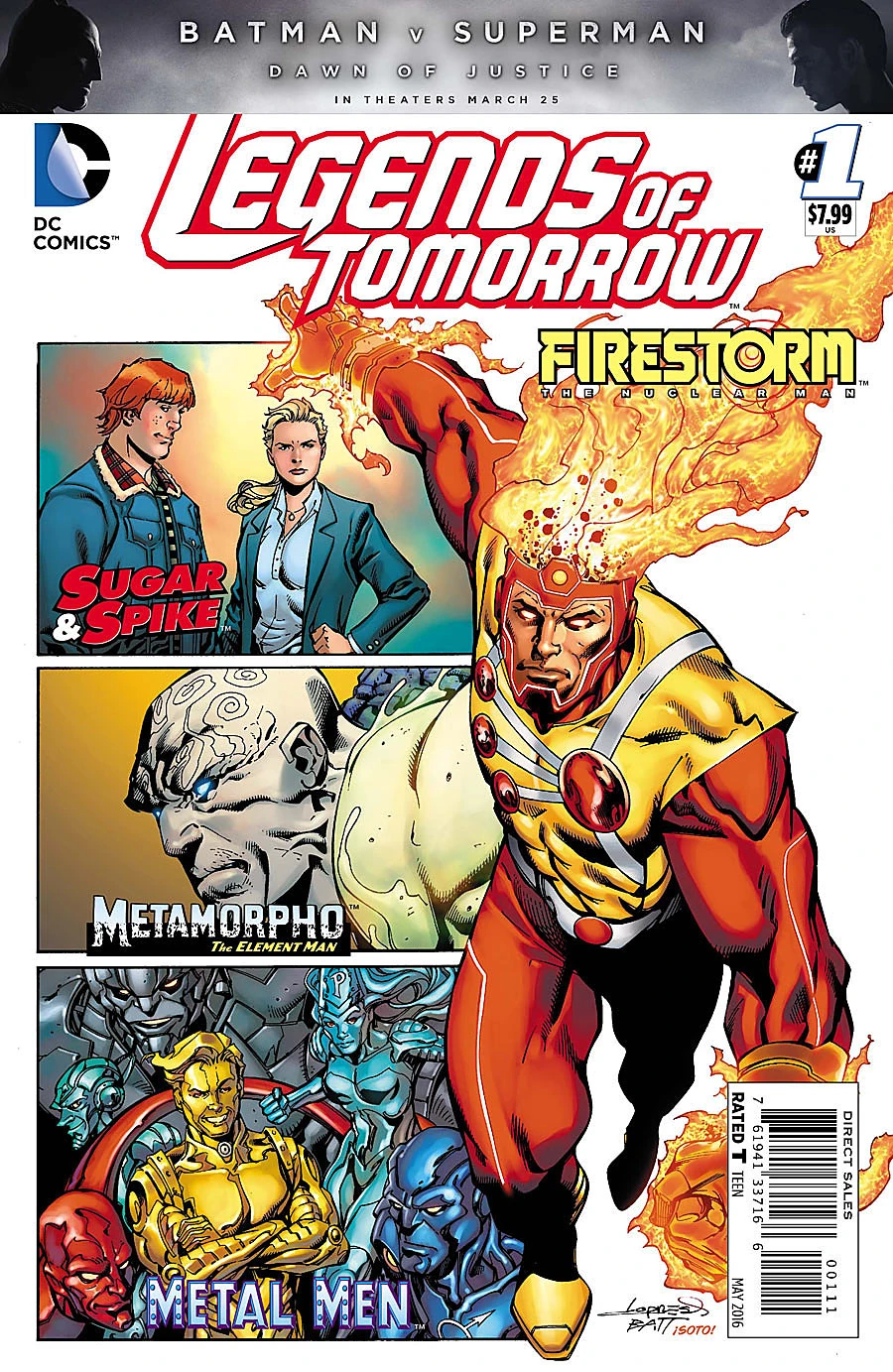
So at some point a few years ago, I was diving into some very cheap comics and came across a book titled Legends of Tomorrow. At that point, I’d been watching the television series pretty regularly and considering Firestorm was on the cover, I thought I’d give it a chance, especially considering it was a $7.99 squarebound book (I still call them “prestige format” books) and I was more than likely getting it for a dollar or less. I picked up the first three issues and remember reading them (although I don’t think I reviewed them) and was bummed to realize that there were three more issues in the series (because at some point, DC wasn’t putting “1 of 6” or whatever on their books).
Flash forward to last month’s Baltimore Comic-Con where I was searching through a very nice and neatly organized set of back issue bins and came across those missing issues. I think I paid $3.00 for each of them, but if you listened to my latest Pop Culture Affidavit episode, you know that I’ll go ahead and drop a little more money on a back issue when I am carrying a huge wad of cash specifically for the convention. And as of this afternoon, I finally got finished reading the entire series.
If you see this series and think it has anything to do with the television show, you’re in for a disappointment … at least if that’s all you’re there for. The book contains four separate stories, each of which run a good 16-20 pages, so just about the length of a comic book. Featured are the aforementioned Firestorm, Metamorpho, Sugar and Spike, and The Metal Men. It was published in 2016 right as DC was entering the Rebirth era, and I have a feeling that these stories might have been a proposed miniseries or something that wound up being smushed into this “collection.” Each of the four stories, by the way, was collected in its own trade after the Legends of Tomorrow series came out.
Anyway, I don’t think that there’s any disappointment to be had when it comes to this book not featuring the characters from the CW show. Writing chores are Gerry Conway on Firestorm, Aaron Lopresti on Metamorpho (he also did the art), Keith Giffen on Sugar and Spike, and Len Wein on Metal Men. That’s a really solid lineup of writers, and while aside from Lopresti, I didn’t recognize the names of any of the artists, they wound up being very solid. But I’m getting ahead of myself.
The Firestorm story features Ronnie Raymond, Jason Rausch, and Martin Stein going up against Multiplex, who has stolen some sort of reality warping device. The three of them are also dealing with the latest set of complications that comes along with being part of the Firestorm Matrix, and the whole thing climaxes in a battle that takes place in an abandoned missile silo where Multiplex threatens to tear reality apart. The Metamorpho story is very much an origin type of story, wherein Rex Mason is still learning to control his brand new powers and everyone seem to be after the Orb of Ra, which takes him through the Great Pyramids of Giza to the other side of the galaxy (yes, like in Stargate). Sugar and Spike are young adults who run a private investigation service and are hired to investigate and in some cases retrieve a bunch of superhero artifacts that are all of goofier Silver Age origin. And the Metal Men have a story that involves scientists scheming against one another, the machinations of The Calculator, a “new” set of Metal Men, and a huge fight against Chemo.
These are fun comics and good reading. While I can’t tell you whether or not they have anything to do with the then-canon of DC’s continuity, they seem to be completely divorced from whatever was going on in the New 52 and Rebirth and allowed to stand on their own as stories. That’s one big reason why they work–no baggage. Another reason they work? The writers all come at it with an eye on the “classic superhero” take but not ignoring contemporary sensibilities; plus, the artists all draw the stories as if they were drawing a superhero comic. That sounds dumb to say, but the superhero art of the last twenty years or so has been wildly inconsistent and in a number of cases tries to look too real or too modern. Here, everything fits the tone of the story and made it all a real treat.
I’d have to say that if I were ranking the four stories in the miniseries, I’d put them in the order of: Sugar and Spike, Metamorpho, Firestorm, and Metal Men. Now, I’d been familiar with the toddler versions of Sugar and Spike from the 1950s–there’s a story or two in The Greatest 1950s Stories Ever Told–and I wasn’t sure what this would be like, considering DC’s knack for taking fairly “innocent” characters and giving them some sort of dark twist. But if there’s one writer who can handle superheroes along with comedy and wit, it’s the late Keith Giffen and this is no exception. The duo are your typical “one’s smart, one’s a doof” (Sugar’s the smart one) and get on one another’s nerves, and their intersection with some of DC’s goofier concepts is a delight because Giffen isn’t holding them up and saying, “Durr-hurrr, look how lame this was”.
And really, all the other stories leaned into an appreciation for the character and their adventures. I was really impressed by Aaron Lopresti’s writing and art on Metamorpho because it looked a lot like classic George Perez, JLGL, or any other Bronze Age artist. Even the Metal Men, whom I’ve never been a big fan of, were fun to read.
So if you come across this miniseries or any of the trades that collected the stories, I recommend checking them out. As for me? I’m holding onto these.
Keep, Sell, Donate, or Trash?
Keep.
 The Uncollecting